Reliable Quantitative & Qualitative Bioanalysis from Discovery to IND-Enabling Studies
Integrated Bioanalysis for Discovery, Translational, and Regulated Development
Our Bioanalysis platform supports discovery, preclinical, translational, and regulated development programs through quantitative and qualitative assays for small molecules, biologics, and emerging therapeutic modalities. By combining scientific flexibility with GLP/GCLP-compliant workflows, the platform enables generation of reliable exposure, biomarker, and mechanistic data across the drug development continuum.
We develop, qualify, validate, and execute fit-for-purpose bioanalytical methods for biological fluids, tissues, formulation samples, and biomarker endpoints to support pharmacokinetics (PK), toxicokinetics (TK), immunogenicity, and translational studies. Integrated workflows enable efficient progression from exploratory discovery studies to regulated development programs without transferring assays, platforms, or analytical context between organizations.
The platform combines LC-MS/MS, high-resolution mass spectrometry, ELISA, and MSD-based technologies to support both exploratory bioanalysis and validated quantitative analysis. Discovery and regulated workflows are supported by infrastructure designed for throughput, reproducibility, data integrity, and compliant sample traceability.
In addition to discovery bioanalysis, the organization supports GLP/GCLP-regulated studies in accordance with current FDA, EMA, NMPA, and ICH guidance. Watson LIMS integration supports audit readiness, data traceability, and regulatory compliance across bioanalytical operations.
Integrated LC-MS/MS and biomarker bioanalysis platform
Small-Molecule and Advanced Modality Bioanalysis
Comprehensive Support for Small Molecules and Emerging Therapeutics
Our small-molecule bioanalysis capabilities support pharmacokinetics, in vitro ADME, tissue distribution, formulation analysis, metabolite quantification, and regulated TK/PK reporting across diverse therapeutic programs.
The platform supports:
- Pharmacokinetics studies
- Toxicokinetics studies
- In Vitro ADME support
- Tissue quantification
- Formulation analysis
- Biomarker quantification
- Regulated bioanalysis workflows
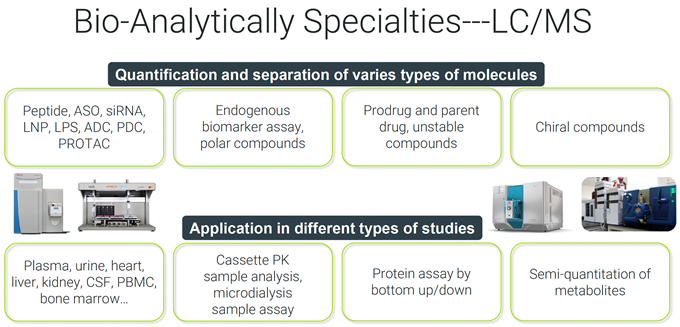
Capabilities span conventional small molecules as well as analytically challenging compounds and biological matrices, including:
- Peptides
- Chiral compounds
- Prodrugs and active metabolites
- Unstable analytes
- Polar compounds
- Low-abundance analytes
- Complex biological and tissue matrices
Tailored sample preparation, extraction, and chromatographic separation, and detection strategies are applied to improve analytical sensitivity, reproducibility, selectivity and matrix compatibility across challenging bioanalytical applications.
The platform also supports a broad range of emerging therapeutic modalities, including:
- PROTACs (hyperlink)
- Antisense oligonucleotides (ASOs)
- siRNA
- Lipid nanoparticles (LNPs)
- ADCs
- AOCs
- PDCs
- Protein degraders and conjugates
These capabilities are valuable for programs requiring integrated characterization of parent drug, payload, linker species, conjugates, biomarkers, and tissue distribution within a unified bioanalytical framework.
LC-MS bioanalysis support for peptides, oligonucleotides, ADCs, and PROTACs
Large-Molecule Bioanalysis & Immunogenicity Assessment
Advanced Workflows for Biologics and Conjugates
Large-molecule therapeutics require bioanalytical workflows capable of addressing molecular complexity, biological interference, immunogenicity risk, and challenging matrix effects.
Our large-molecule bioanalysis platform supports:
- Monoclonal antibodies
- Bispecific and trispecific antibodies
- ADCs
- PDCs
- AOCs
- proTCEs
- Protein therapeutics
Capabilities include:
- Quantitative PK bioanalysis
- Conjugate and payload characterization
- Characterization and quantification workflows
- Bioassay development, qualification, and validation
- ADA assay development and validation
- Immunogenicity assessment
- Biomarker analysis
ELISA, MSD, and LC-MS-based workflows support both quantification exposure analysis and translational interpretation. These integrated approaches help teams determine whether changes in exposure or efficacy are associated with immunogenicity, target-mediated drug disposition, conjugate stability, payload release, formulation behavior, or tissue-level biological activity.
The platform is particularly valuable for biologics and conjugate programs where systemic exposure alone may not fully account for pharmacological response, durability, or safety observations.
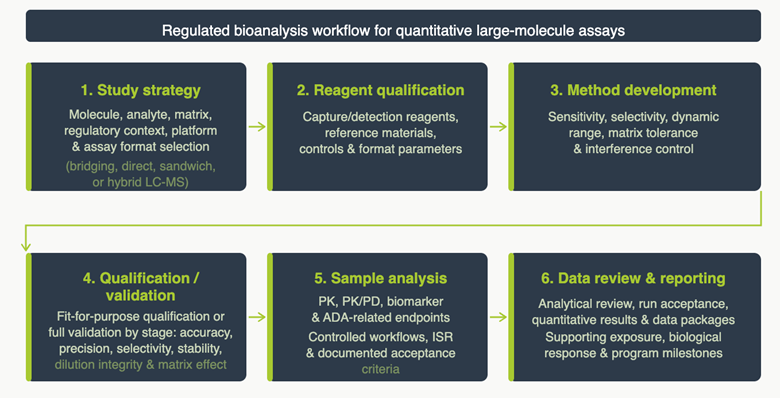
Regulated Bioanalysis Workflow for Quantitative Large-molecule Assays
Biomarker Analysis and Translational Support
Connecting Exposure to Biological Response
Integrated biomarker analysis supports translational assessment by linking drug exposure to pharmacodynamic activity, pathway modulation, and biological response across discovery and preclinical development programs.
Our biomarker capabilities include:
- Quantitative biomarker analysis
- Assay development, qualification and validation
- Translational PK/PD biomarker support
- Metabolomics support
- Proteomic biomarker analysis
- Endogenous biomarker profiling
Quantifiable analytes include:
- Disease-relevant metabolites
- CNS-associated lipids
- Hormonal and endocrine markers
- Energy metabolism biomarkers
- Inflammatory and immune-response markers
- Oncology-associated metabolites
- Safety and toxicity-associated biomarkers
The platform currently supports more than 200 endogenous biomarkers across multiple therapeutic areas and biological systems. These datasets help strengthen PK/PD interpretation, safety assessment, translational modeling, and biological pathway analysis across preclinical studies.
LC-MS/MS biomarker analysis platform for translational drug development

Analytical Instrumentation and Platform Scale
State-of-the-art Technology with High Throughput
Our analytical infrastructure supports exploratory discovery workflows as well as regulated quantitative bioanalysis programs requiring high sensitivity, reproducibility, scalability and throughput.
Core instrumentation includes:
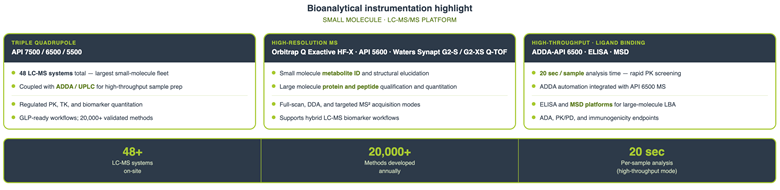
- API 7500 LC-MS/MS systems
- API 6500 LC-MS/MS systems
- API 5500 LC-MS/MS systems
- Thermo Scientific Q Exactive Orbitrap high resolution mass spectrometry systems
- Waters G2-S QTOF and Waters G2-XS QTOF platforms
- ELISA-based analytical platforms
- MSD platforms
Platform scale and capabilities:
- More than 48 mass spectrometry systems
- High-throughput LC-MS/MS and HRMS workflows
- Discovery and regulated bioanalysis support
- Targeted biomarker and metabolite analysis
- Tissue, formulation, and complex matrix bioanalysis
- Integrated support for PK, TK, immunogenicity, and translational studies
These integrated analytical systems support quantitative and qualitative workflows across small molecules, peptides, proteins, oligonucleotides, metabolites, conjugates and biomarkers.
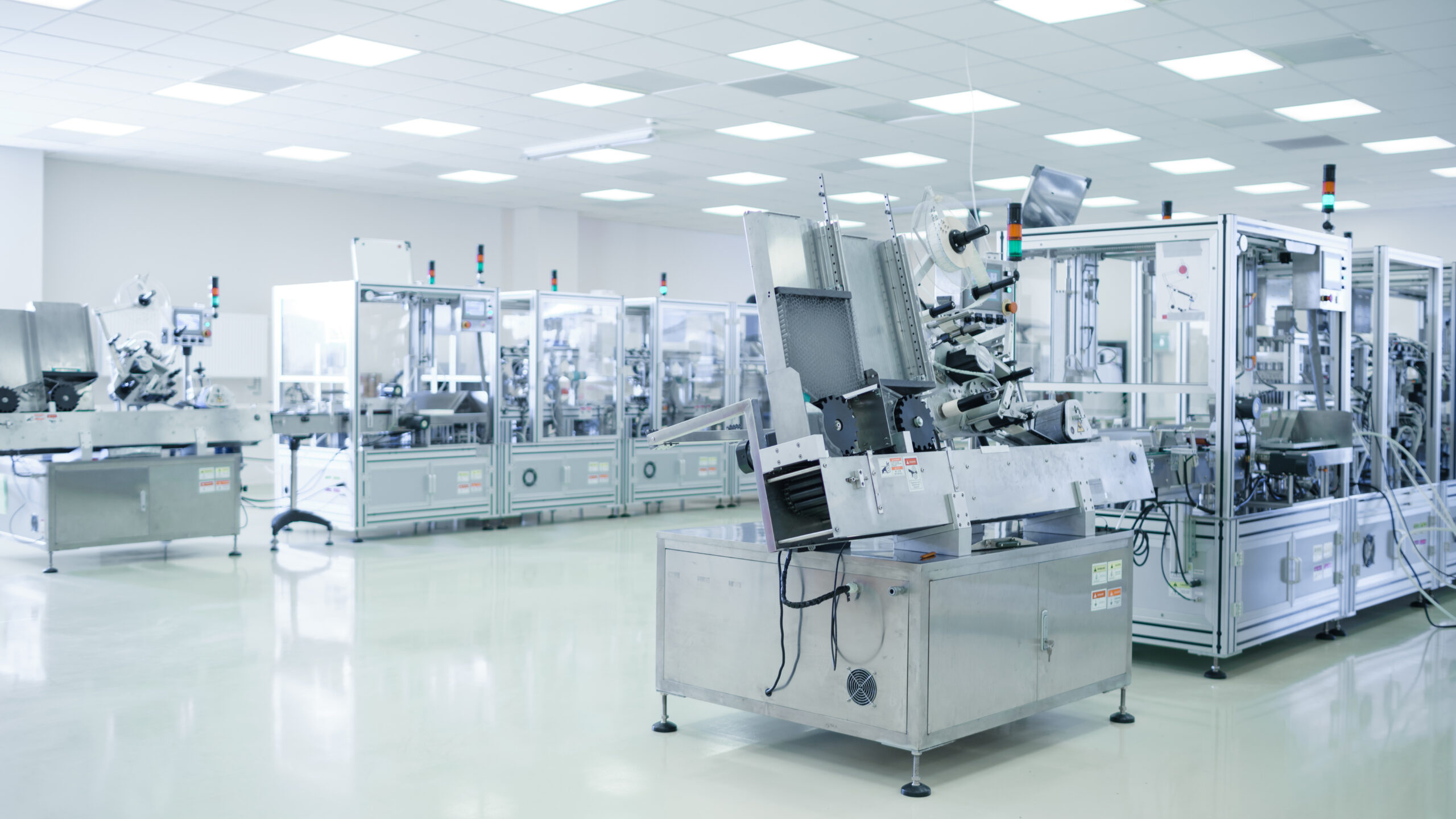
High-throughput LC-MS/MS instrumentation for discovery and regulated bioanalysis
GLP/GCLP Compliance and Data Integrity
Regulatory-Ready with Full Traceability
Our regulated bioanalysis workflows are designed to support data quality, traceability, and regulatory compliance across preclinical and clinical development programs.
Capabilities include:
- GLP/GCLP-compliant bioanalytical workflows
- Watson LIMS integration
- Regulated method qualification and validation
- Audit-ready documentation and reporting
- Studies aligned with FDA, EMA, NMPA, and ICH guidance
- Secure analytical data management and traceability
- Toxicokinetic bioanalysis support
This infrastructure enables efficient transition from exploratory discovery studies into IND-enabling and regulated development programs while maintaining assay continuity, platform consistency and data integrity across development stages.
Integrated Bioanalysis Across DMPK and Translational Development
Because bioanalysis is integrated within a broader DMPK, pharmacokinetics, formulation, and exploratory toxicology organization, analytical findings can be connected directly to:
- In Vitro ADME
- Pharmacokinetics
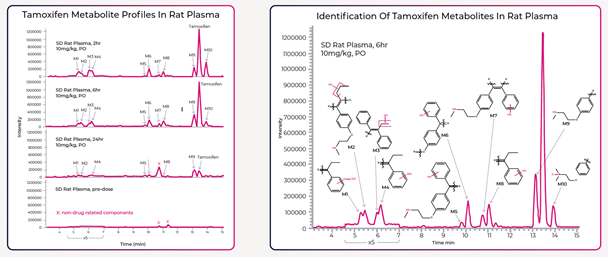
- Metabolite identification and profiling
- Biomarker and PK/PD analysis
- Exploratory toxicology
- IND-enabling strategy
This integrated scientific framework supports translational interpretation, cross-functional data integration, and more efficient progression between analytical, pharmacological, and regulatory workflows.
Discuss Your Bioanalysis Strategy
Whether you are supporting discovery screening, biomarker analysis, regulated toxicokinetic studies, or complex modality development, our scientists can help design integrated bioanalytical strategies tailored to your program goals.

Request a Bioanalysis Consultation
Explore Integrated DMPK Support
FAQs
What is bioanalysis used for in drug development?
Bioanalysis quantifies drugs, metabolites, biomarkers, and biologics to support PK, TK, ADME, and translational development studies.
What modalities can bioanalysis support?
Modern bioanalysis platforms support small molecules, peptides, oligonucleotides, ADCs, biologics, PROTACs, and related therapeutic formats.
What technologies are used in bioanalysis?
Common technologies include LC-MS/MS, high-resolution mass spectrometry, ELISA, MSD, and ligand-binding assays.
What is regulated bioanalysis?
Regulated bioanalysis follows GLP/GCLP and global regulatory guidance to support IND-enabling and clinical development programs.
Why are biomarkers important in bioanalysis?
Biomarkers help connect drug exposure to biological response and improve translational and mechanistic interpretation.
Can bioanalysis support complex biological matrices?
Yes. Bioanalysis workflows support plasma, serum, CSF, tissues, PBMCs, urine, ocular matrices, and other challenging biological samples.