


De-Risk your compounds earlier. Optimize faster. Advance with confidence.
In vitro ADME studies are essential in modern drug discovery. They provide early insight into the absorption, distribution, metabolism, and excretion properties of drug candidates, before progression into costly in vivo studies and IND-enabling work.
Our integrated in vitro ADME platform delivers rapid, reproducible, and decision-enabling data across both traditional small molecules and emerging therapeutic modalities (ADCs, peptides, PROTACs, and oligonucleotides, etc.). Through automated workflows, fit-for-purpose assay design, broad analytical capabilities, and deep scientific expertise, we help discovery teams identify liabilities early, guide medicinal chemistry optimization, and improve overall developability.
Why In Vitro ADME Matters in Drug Discovery
Many promising compounds fail during preclinical development due to inadequate metabolic stability, poor permeability, suboptimal exposure, or unanticipated drug-drug interaction potential. Early in vitro ADME profiling supports:
- Predict clearance and estimate in vivo exposure
- Identify metabolic and interaction liabilities
- Optimize structure-property relationships
- Prioritize compounds and support confident go/no-go decisions
Our platform is designed to address key developability questions, including:
- Is the compound likely to exhibit rapid metabolic clearance?
- Is systemic exposure likely to be sufficient in vivo?
- Could transportern activity limit absorption or CNS penetration?
- Does the compound present CYP- or transporter-mediated DDI risk?
- Is protein binding likely to affect free drug exposure?
- Could physicochemical properties introduce formulation challenges?
Metabolic Stability & Clearance
Predict clearance, understand metabolic pathways, and optimize half-life early
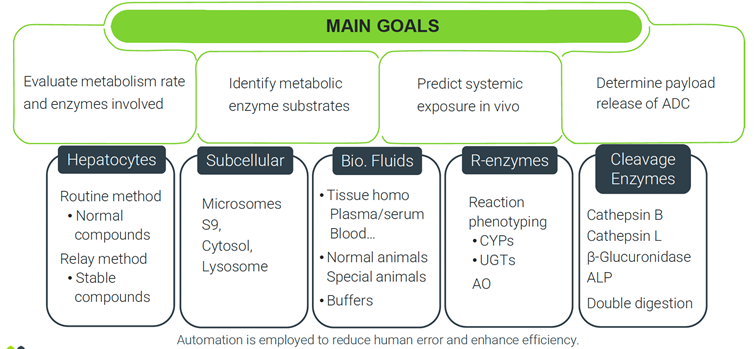
Our metabolic stability and clearance platform evaluates biotransformation across multiple systems to support structure-metabolism relationships and in vitro-to-in vivo extrapolation.
Key Systems Supported:
- Liver microsomes, S9 fractions, cytosol, and primary hepatocytes
- Plasma, whole blood, and lysosomal stability
- Recombinant CYP, UGT, and aldehyde oxidase systems
- GSH trapping and reactive metabolite screening
- Relay hepatocyte assays for extended incubation
We support both conventional small molecules and complex therapeutic modalities such as ADCs, peptides, oligonucleotides, and PROTACs, with additional focus on linker stability and payload release where relevant.
Metabolic stability and clearance assay workflow
Drug-Drug Interaction (DDI) Assessment
Identify and mitigate interaction risks early in development.
Our DDI platform generates regulatory-relevant data to evaluate CYP- and transporter-mediated interaction potential.
Core Offerings:
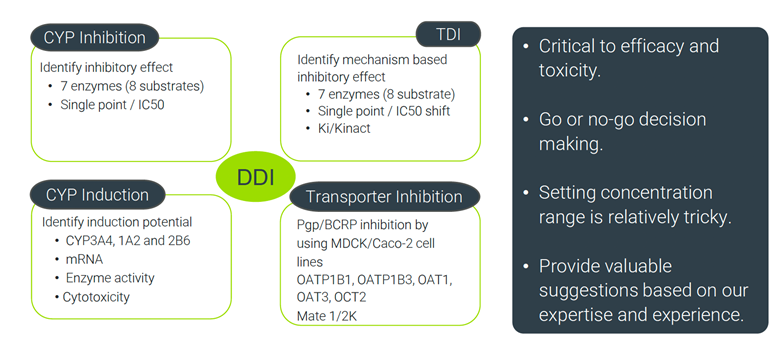
- CYP inhibition and time-dependent inhibition (TDI)
- IC50 determination
- Ki/Kinact characterization
- CYP induction studies
- CYP reaction phenotyping
- Transporter inhibition and substrate evaluation
Studies cover major CYP isoforms and clinically relevant transporters including P-gp, BCRP, OATP1B1/1B3, etc.). Data packages are designed to support compound optimization, risk assessment, and regulatory submissions.
Drug-drug interaction assessment including CYP inhibition and induction studies
Transporter Assays and Permeability Studies
Understand absorption, distribution, and transporter-mediated risks.
Transporters can significantly influence oral absorption, tissue distribution, clearance, CNS penetration, and DDI potential.
Transporter platform capabilities:
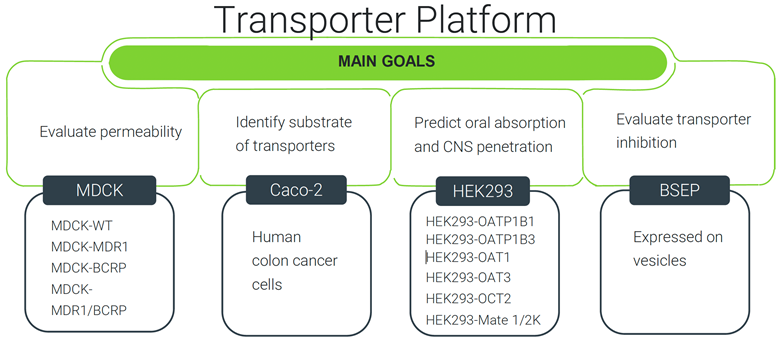
- Caco-2 bidirectional permeability
- MDCK wild-type permeability models
- MDR1- and BCRP-mediated efflux models
- HEK293 transporter-expressing systems
- Vesicle-based transporter assays
- Key transporters evaluated include: P-gp, BCRP, OATP1B1, OATP1B3, OAT1, OAT3, OCT2, MATE1/2K
We deliver clear insights into passive permeability, efflux liability, and transporter-mediated DDI risk to support compound optimization and developability assessment.
Transporter and permeability assay models
Protein Binding and Distribution Studies
Accurately determine free drug concentration and distribution properties
Our protein binding and distribution platform includes:
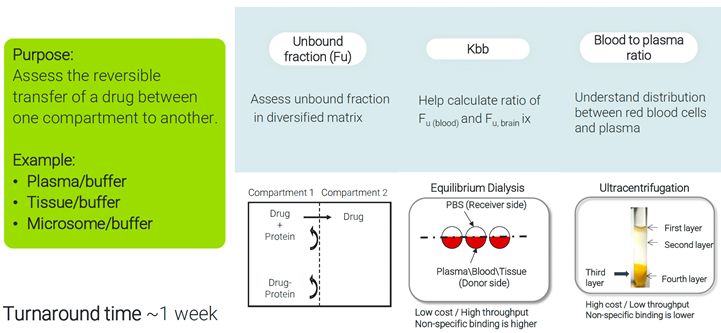
- Plasma protein binding assays (equilibrium dialysis & ultracentrifugation)
- Tissue binding studies
- Microsomal binding assays
- Blood-to-plasma partitioning
- Red blood cell partitioning studies
These studies support PK/PD interpretation, exposure modeling, and translation of pharmacological and safety findings.
Equilibrium dialysis for plasma protein binding
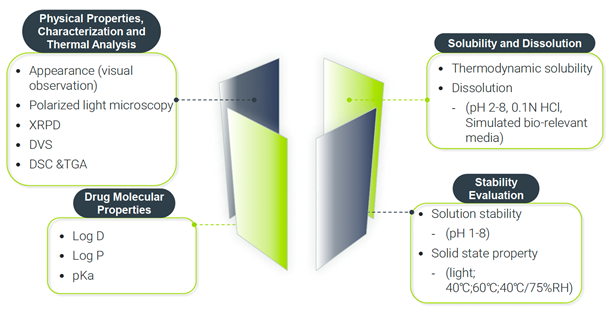
Physicochemical Profiling for Developability
Build better drug candidates through early characterization of key physicochemical properties
Physicochemical properties often determine whether potent compounds can progress intoviable drug candidates. Early profiling helps identify formulation, exposure, and stability risks before they become significant development challenges.
Capabilities include:
- Solubility assessment
- Log D and Log P determination
- pKa evaluation
- Chemical stability studies
- Solution stability studies
- Dissolution analysis
- Particle size characterization
These data support medicinal chemistry optimization, formulation strategy, and overall developability assessment
Physicochemical Profiling Dashboard
Metabolite Identification & Biotransformation
Elucidate metabolic pathways using high-resolution mass spectrometry
Metabolite identification studies provide critical insight into biotransformation pathways, species differences, exposure profiles, and the formation of human-relevant metabolites.
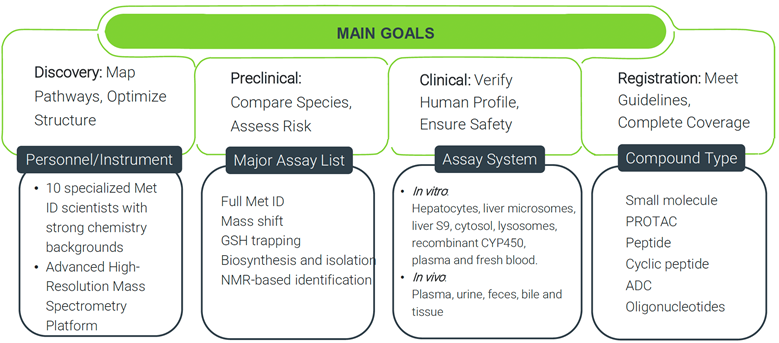
Our metabolite identification platform integrates in vitro and in vivo systems with high-resolution mass spectrometry to support:
- Metabolic pathway mapping
- Cross-species comparison
- Human metabolite identification and verification
- GSH trapping and reactive metabolite assessment
- Metabolite biosynthesis and isolation
- Structural elucidation
- Regulatory submission support
Modalities supported:
- Small molecules
- Peptides
- Cyclic peptides
- ADCs
- PROTACs
- Oligonucleotides
This integrated approach helps connect metabolism data to broader DMPK, exposure, and safety assessments.
How metabolite identification supports drug discovery from lead optimization through clinical development.
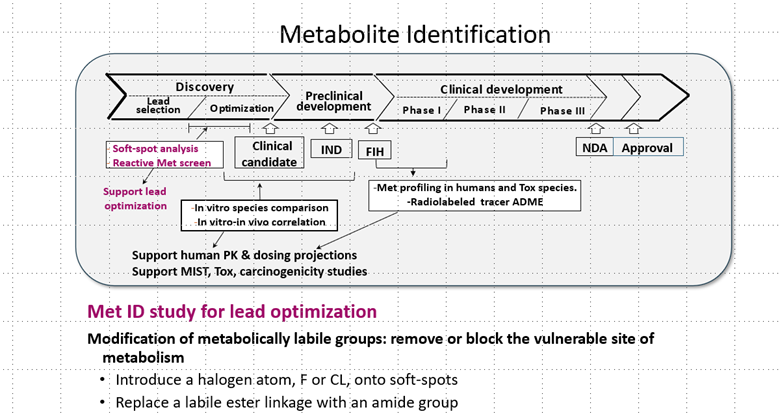
Identify unstable parts of a molecule, make chemistry changes, improve exposure and reduce safety risk.
Metabolite identification workflow
Integrated DMPK Support
Our in vitro ADME platform is integrated within a broader DMPK, bioanalysis, formulation, and toxicology framework, enabling continuity from early discovery through preclinical development and IND-enabling studies.
Ready to Move Your Program Forward?
Discuss Your In Vitro ADME Strategy
Whether you are prioritizing hits, optimizing leads, or advancing toward IND-enabling studies, our scientists can help design integrated in vitro ADME strategies tailored to your discovery and development goals.

FAQs
What is In Vitro ADME?
In Vitro ADME refers to laboratory studies that characterize absorption, distribution, metabolism, and excretion properties of compounds prior to in vivo studies and later-stage development.
Why are metabolic stability studies important?
Metabolic stability studies help estimate intrinsic clearance, exposure, and half-life while identifying metabolic liabilities that may impact pharmacokinetics, efficacy, or safety.
What are common DDI studies?
Common drug-drug interaction studies include CYP inhibition, CYP induction, time-dependent inhibition (TDI), transporter inhibition, and substrate characterization.
Why are transporter assays important?
Transporter assays help assess the potential impact of transport proteins on oral absorption, tissue distribution, CNS exposure, and drug-drug interaction risk.
What is the purpose of protein binding studies?
Protein binding studies determine the fraction of unbound (free) drug in plasma and support interpretation of pharmacokinetic and pharmacodynamic relationships.
Can in vitro ADME support complex modalities?
Yes. Modern in vitro ADME platforms can be applied to a range of modalities, including peptides, ADCs, oligonucleotides, PROTACs, and other conjugated or emerging therapeutic formats, in addition to small molecules.